Malware
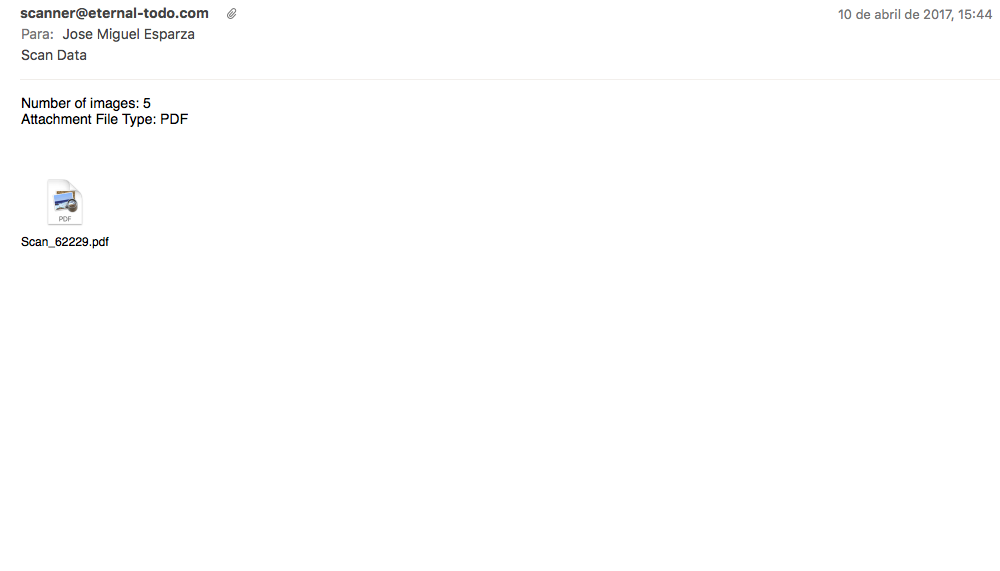
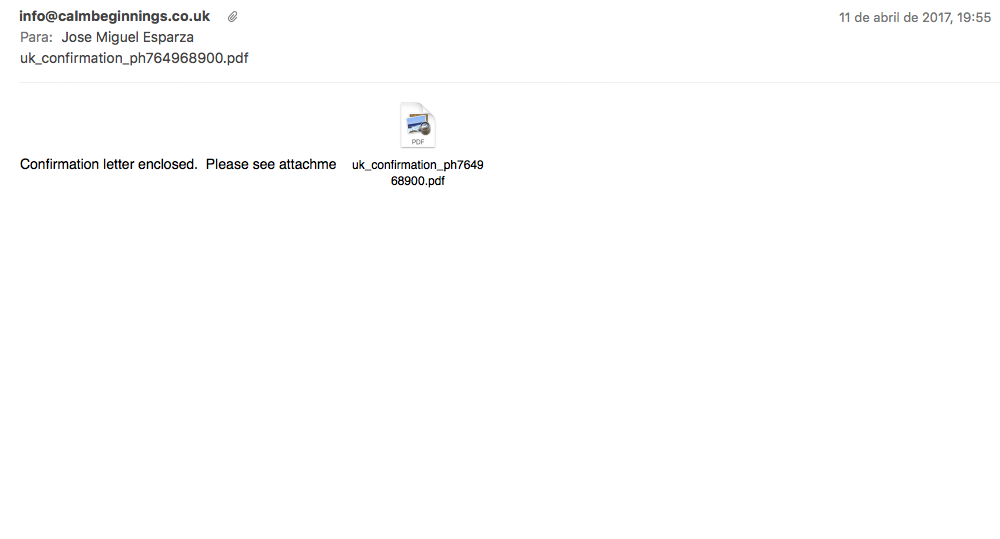
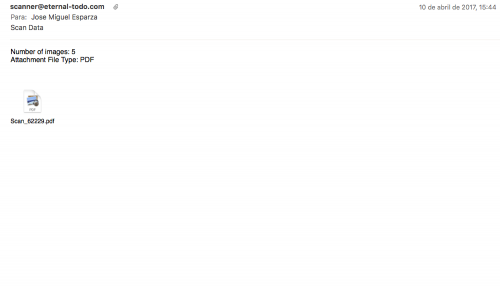
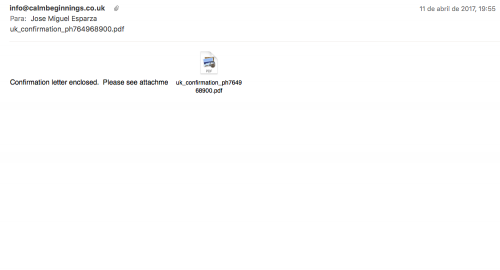
During this month a Dridex spam campaign using PDF documents as infection vector was spotted. I also received a couple of e-mails in my personal inbox attaching the mentioned PDF files. One of them was using the typical “scanned data” theme (subject was “Scan data” and sender “scanner at eternal-todo.com”) and the other one was related to a confirmation letter (subject was “uk_confirmation_ph764968900.pdf” and the sender “info at calmbeginnings.co.uk”). None of them was really good in social engineering, just adding some words and the attachment.
Submitted by jesparza on Mon, 2017/04/24 - 01:24
It has been a while since I wrote the last time here and since I presented at Botconf, but I wanted to share my slides here too. A couple of weks after the sad terrorist attacks in Paris, Botconf was held in the city of love. Way more secure than before and with lots of security controls which almost made me lose my return train, but it was worth it. Attending a security conference focused on cybercrime, malware, reverse engineering and intelligence is always a good plan :) I really recommend you attending Botconf this year in Lyon, you will not regret it ;)
My presentation was about Andromeda. This is the abstract:
Andromeda, also known as Gamarue by some Antivirus vendors, is a popular and modular bot active since 2011. It is normally used to spread additional malware, but sometimes, depending on the criminals, the main objective could be just stealing user credentials. After almost five years of life its development has not stopped. The people behind it keep maintaining it and adding functionalities, like new anti-analysis routines, changes in the communication encryption, new request formats, etc.
This talk will not give just details about the latest changes in the Andromeda binary and control panel, but it will also respond some interesting questions about this botnet. Which are the most popular versions used nowadays? Are most of the botnets spreading malware or just using its plugins? What are the most popular plugins? How and where is Andromeda sold? Who is selling it? What criminal groups are using Andromeda? It is not just a talk about malware reversing but about the whole Andromeda ecosystem.
Submitted by jesparza on Sun, 2016/02/07 - 23:09
Two months ago Google announced that Google Code was slowly dying: no new projects can be created, it will be read only soon and in January 2016 the project will close definitely. peepdf was hosted there so it was time to move to another platform. The code is currently hosted at GitHub, way more active than Google Code:
https://github.com/jesparza/peepdf
If you are using peepdf you must update the tool because it is pointing to Google Code now. After executing “peepdf.py -u” the tool will point to GitHub and it will be able to be up to date with the latest commits. The peepdf Google Code page will also point to GitHub soon.
Another important announcement is that Rohit Dua will be the student who will work with peepdf this summer in the Google Summer of Code (GSoC). I initially presented three ideas to improve peepdf through The Honeynet Project:
Submitted by jesparza on Tue, 2015/05/05 - 21:34
After my last post about Andromeda different updates related to version 2.07 and 2.08 appeared. Mostly, Fortinet was talking about the version 2.7 features and the new anti-analysis tricks of version 2.08. After that, Kimberly was also mentioning version 2.09 in his blog but I have not seen too many details about the latest versions of Andromeda. This is a summary of the interesting details about the newer versions.
Andromeda versions
After version 2.08, the parameter used to send the bot version to the panel was removed from the POST request, so now it is a bit more difficult to distinguish between versions. An easy way to spot the different versions is taking a look at the request format strings:
-
id:%lu|bid:%lu|bv:%lu|sv:%lu|pa:%lu|la:%lu|ar:%lu (<=2.06)
-
id:%lu|bid:%lu|bv:%lu|os:%lu|la:%lu|rg:%lu (2.07/2.08)
-
id:%lu|bid:%lu|os:%lu|la:%lu|rg:%lu (2.09)
Submitted by jesparza on Fri, 2015/04/17 - 01:47
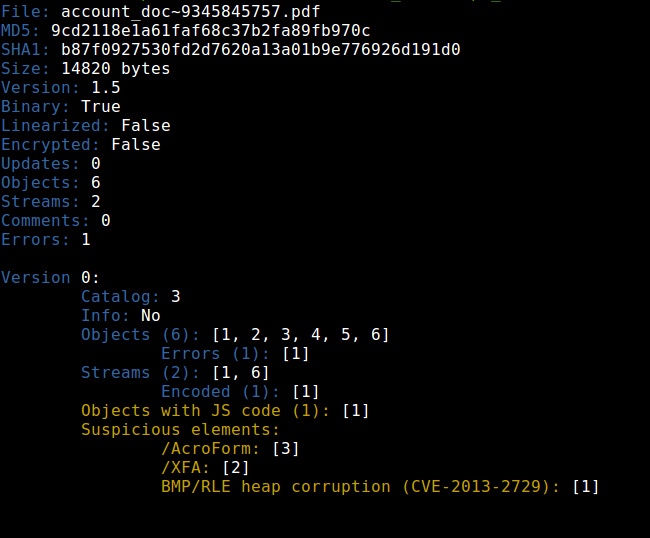
Some months ago I analyzed some PDF exploits that I received via SPAM mails. They contained the vulnerability CVE-2013-2729 leading to a ZeuS-P2P / Gameover sample. Back in June I received more PDF exploits, containing the same vulnerability, but in these cases it was a bit more difficult to extract the shellcode because the code was obfuscated. This is what we can see taking a look at the file account_doc~9345845757.pdf (9cd2118e1a61faf68c37b2fa89fb970c) with peepdf:
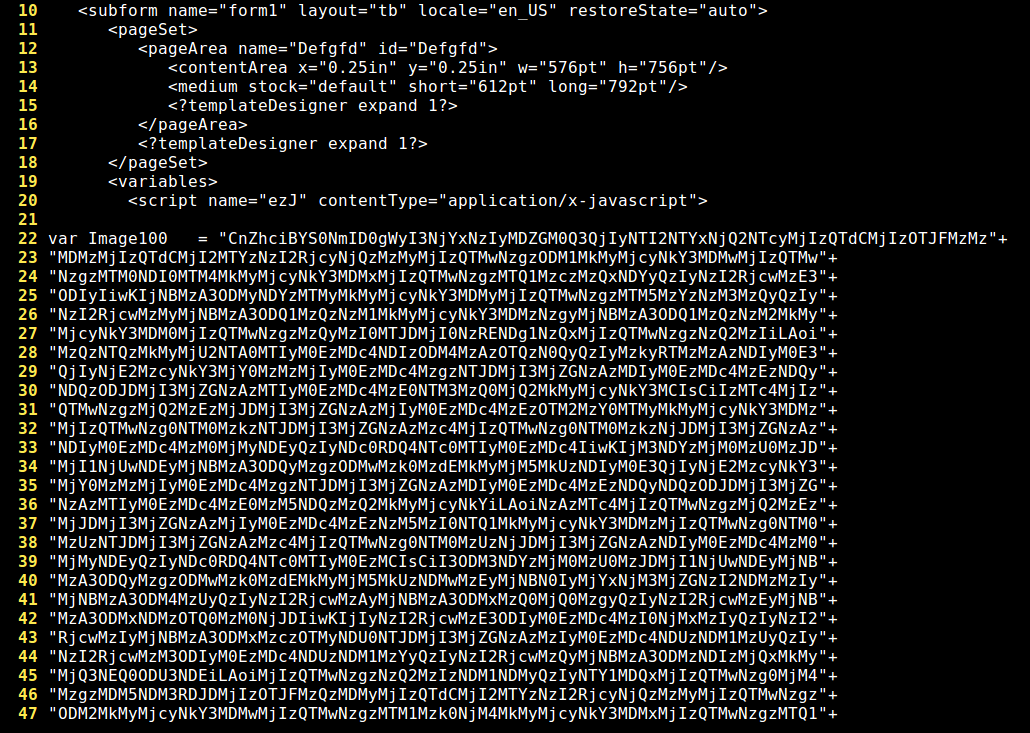
It seems that they used the same PDF exploit and they just added the obfuscation, because if we compare the peepdf output for the previous exploits we can see the same number of objects, same number of streams, same object ids, same id for the catalog, etc. After extracting the suspicious object (1) you can spot the shellcode easily, but some modifications are needed:
PPDF> object 1 > object1_output.txt
We can see two “images” encoded with Base64:
Submitted by jesparza on Thu, 2014/10/16 - 03:53
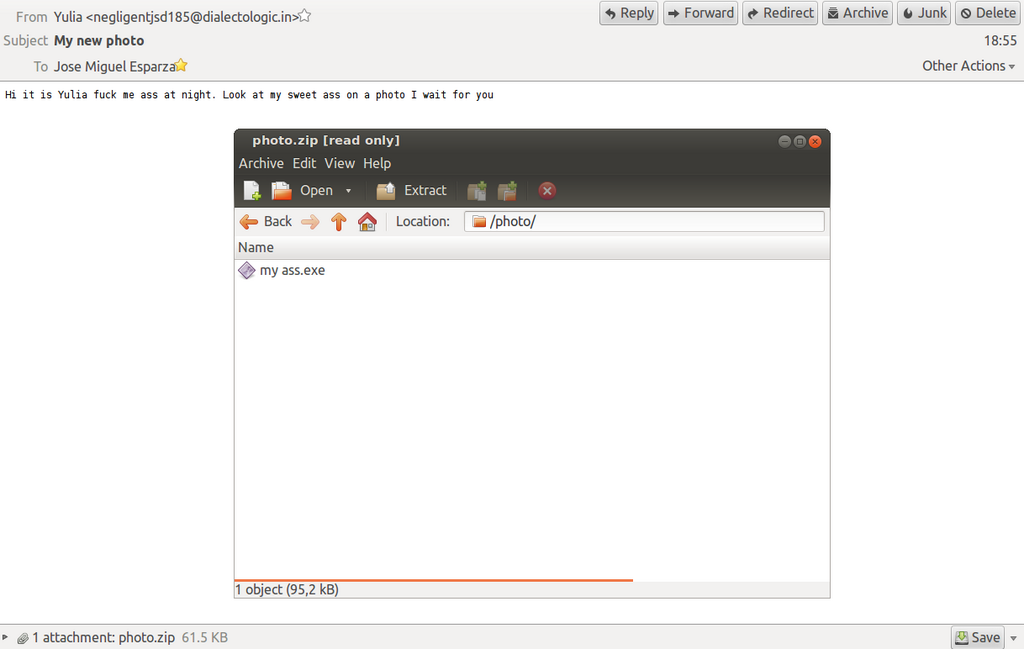
In mid-August I started receiving some emails from Yulia. She wanted me to take a look at her sweet ass:
I was not sure about it, but after receiving some more emails like this I took a look (I received the last one on the 10th of September). Then I found out that this was the beginning of a SmokeLoader campaign, I was really disappointed :( Out of spite, I started analyzing it ;p
These are some of the headers and the message body:
Date:   Wed, 13 Aug 2014 12:55:56 -0400
From:   "Yulia" <negligentjsd185@dialectologic.in>
Subject: My new  photo

Hi it is Yulia fuck me ass at night. Look at my sweet ass on a photo I wait for you
I don't want to duplicate the information already published about this loader, so you can check the post published in July by StopMalvertising and what my colleague Michael Sandee said about it in 2012. Since then, SmokeLoader (known as Dofoil too) has modified the encryption to communicate with the C&C, added some extra plugins, etc.
After executing the binary you can easily spot that something is happening in your computer because you can see some strange POST requests to some known URLs. These URLs are extracted from the registry, opening the key Software\Microsoft\Windows\CurrentVersion\Uninstall and looking at the values of HelpLink and URLInfoAbout for the installed programs.
Submitted by jesparza on Sun, 2014/10/05 - 22:03
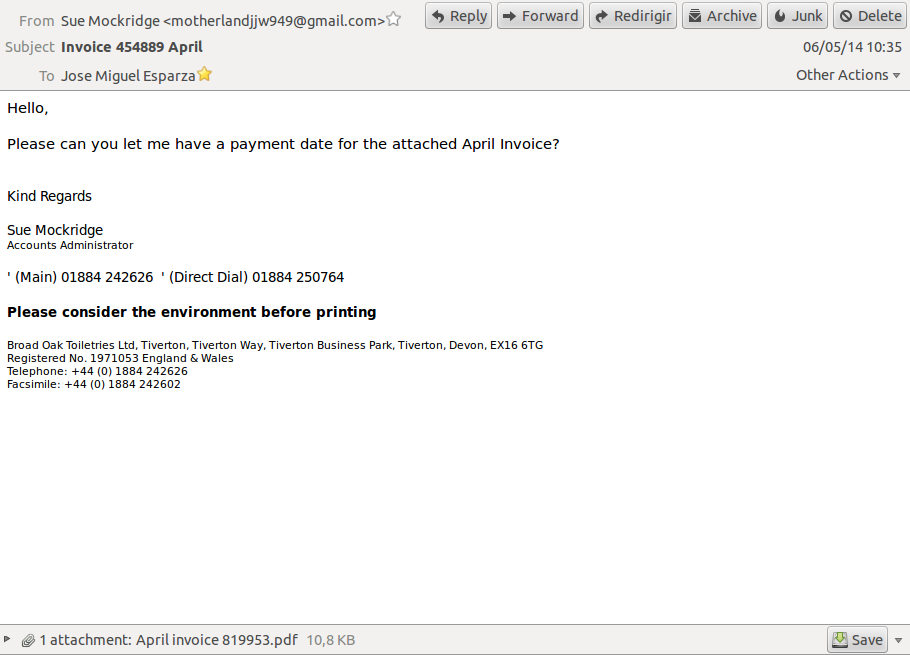
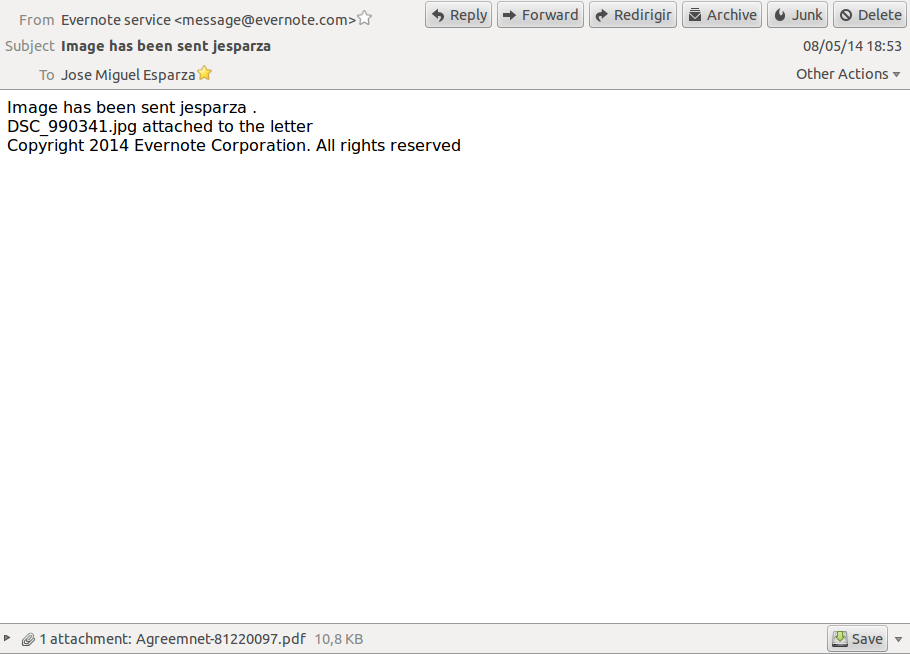
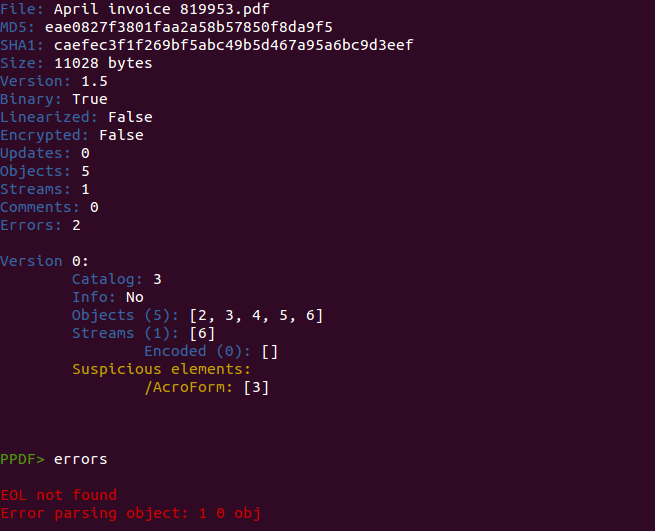
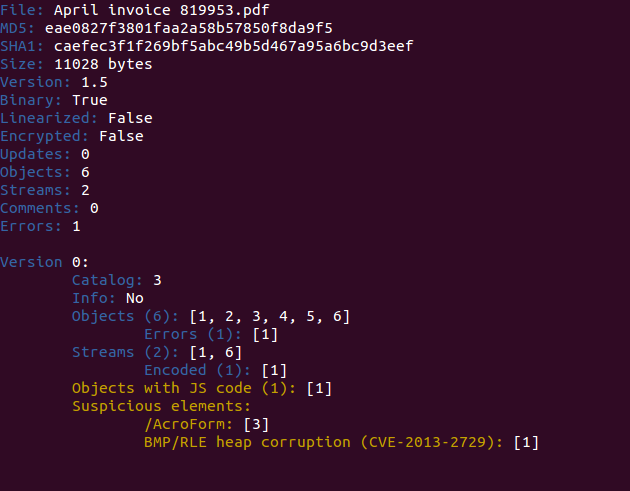
I am used to receive SPAM emails containing zips and exes, even "PDF files" with double extension (.pdf.exe), but some days ago I received an email with a PDF file attached, without any .exe extension and it didn't look like a Viagra advertisement. Weird. I didn't have time to take a look at it, but the next day I received another one, with a different subject. The subject of the first email was “Invoice 454889 April” from Sue Mockridge (motherlandjjw949 at gmail.com) attaching “April invoice 819953.pdf” (eae0827f3801faa2a58b57850f8da9f5), and the second one “Image has been sent jesparza” from Evernote Service (message at evernote.com, but really protectoratesl9 at gmail.com) attaching “Agreemnet-81220097.pdf” (2a03ac24042fc35caa92c847638ca7c2).
At this point I was really curious so I took a look at them with peepdf.
Submitted by jesparza on Tue, 2014/05/20 - 23:51
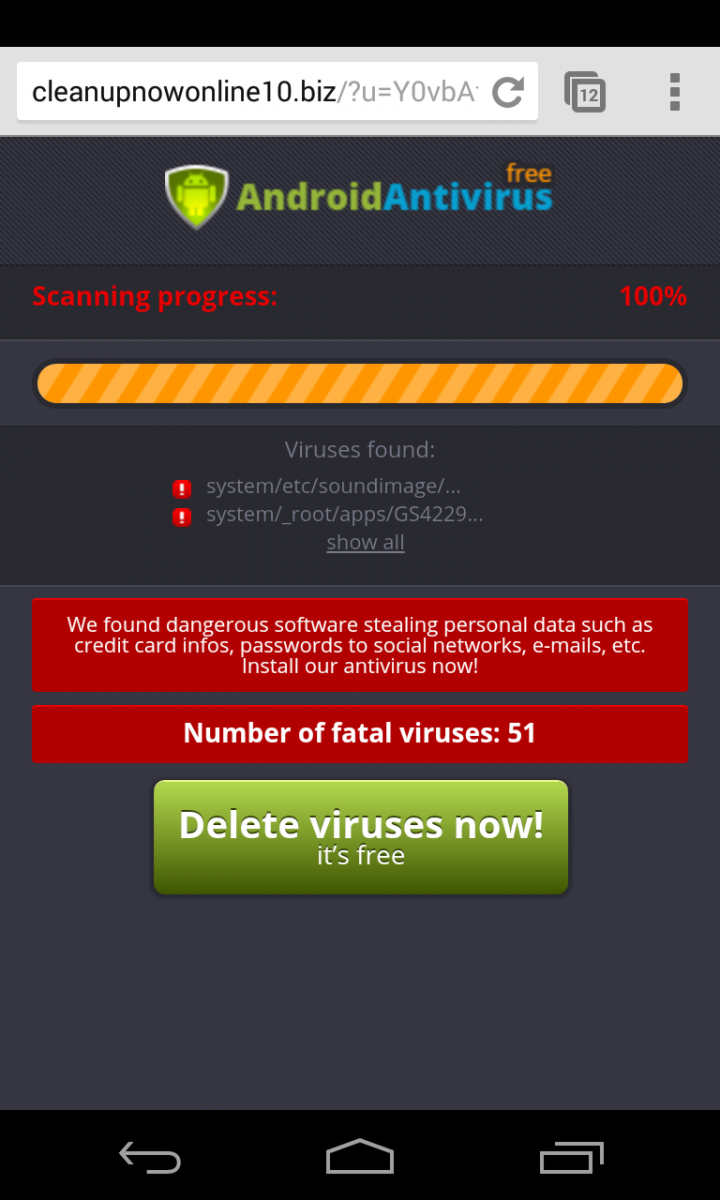
One month ago I was trying to find a streaming site to watch a Spanish soccer match and I found futbolenvivoaldia.com. It was a redirection to the famous site Tarjeta Roja, but the interesting thing was that when I browsed the site with my mobile phone I saw the typical Antivirus scanner saying that my device was infected. Also, an app called “androidav_free.APK” (24f0a666a714e26c6c07ab407e37b112) was trying to be downloaded to my device.
The source of this fake page was one of the advertisement networks of the site tarjetaroja.eu, Mobicow. After some redirections and some tracking URLs this network was returning the following URL to the user's browser:
hxxp://cleanupnowonline10.biz/?u=Y0vbAf0fW9lIhVAxPi2nZQo
This page was loading Javascript code from here:
hxxp://cleanupnowonline10.biz/js/wapc.js
The code was obfuscated and this was the second stage of Javascript code:
Taking a look at the script content we can see that it contains all the functions necessary to show the fake infection page to the user. Also, we can see that the following URL was used to download the app:
hxxp://cleanupnowonline10.biz/apk.php
Submitted by jesparza on Mon, 2013/10/28 - 03:10
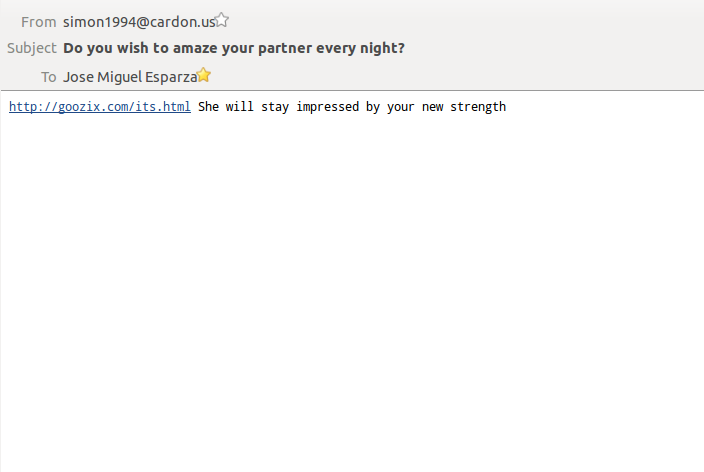
I was already missing these SPAM emails with some advice about my sexual life: “Your woman wants you to be the best lover”, “The greatest technique to gratify your lady”, etc. I was getting upset about this, I needed some help...;p
So finally I am receiving a lot of these again. After visiting the link (hxxp://goozix.com/its.html) we can see a redirection to a page to buy Viagra and other “medicines”. But also there is some malicious Javascript code hidden there. The result of the deobfuscation contains code to create a cookie (“visited_uq=55”) and also an iframe to load the URL hxxp://gylaqim.com/exit.php. This domain, created on the 21st of September, resolves each time to a different IP and has a history of more than 400 IPs. It has 6 authoritative DNS servers, ns*.gylaqim.com, also resolving to multiple IPs.
Depending on the server which is responding after visiting hxxp://gylaqim.com/exit.php we will be redirected to another initial page - with another redirection to a Viagra site plus malicious Javascript code - or to the actual exploit kit.
The initial pages seen until the moment are the following:
hxxp://178.170.104.124/destruction.html
hxxp://178.170.104.124/seed.html
hxxp://actes-lyon.org/true.html
hxxp://aybabtu.ru/express.html
hxxp://brave.net.nz/ocean.html
hxxp://goozix.com/its.html
hxxp://moniwild.sakura.ne.jp/average.html
hxxp://rodinr.511.com1.ru/angle.html
hxxp://southeasterntrains-fail.com/somewhere.html
hxxp://toys-store.net/dawn.html
Submitted by jesparza on Tue, 2013/10/08 - 00:11
Some days ago I read the post about Joe Security's error when they analyzed an Andromeda sample and I also found new samples of this Trojan. Then I decided that I should write something about it. At least, just to remember some tricks of Andromeda for the next time and not starting from scratch. I'm Dory, I forget things ;)
When I analyzed this malware some months ago I thought that it was quite interesting due to the Anti-debugging and Anti-VM tricks it uses. You can also find references to the same malware with the name of Gamarue. It seems it is cool to rename the same malware with different names. Then you can find some families with three different names, like Cridex / Feodo / Bugat. Anyway, I also found these two links with very good and detailed information about analyzing Andromeda:
Submitted by jesparza on Sun, 2013/09/01 - 19:56
Just some hours after the bombings during the Boston Marathon we already had several spam campaigns using that subject to infect users. It seems that cybercriminals don't respect anything, did we really expect something different? :p
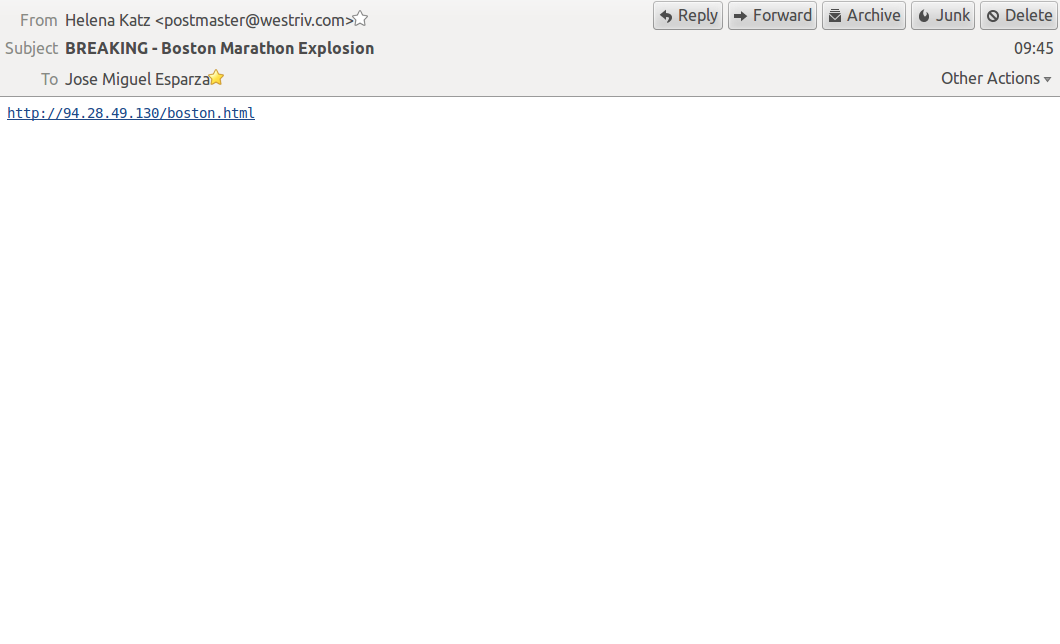
On the past Wednesday I received four emails talking about the Boston incident. They were really suspicious, just a URL in the body, the URLs had just an IP instead of a good domain...I think someone was in a rush trying to profit from this as soon as possible, while it was still on the news...
The subjects were:
BREAKING - Boston Marathon Explosion
Explosion at the Boston Marathon
Aftermath to explosion at Boston Marathon
Explosions at the Boston Marathon
And the URLs I saw:
hxxp://94.28.49 .130/boston.html
hxxp://78.90.133 .133/boston.html
hxxp://118.141.37 .122/news.html
hxxp://110.92.80 .47/news.html
These URLs leaded to a simple webpage with six iframes. Five of them pointed to real videos about the tragedy and the other one redirected to a RedKit exploit kit which was trying to exploit a CVE-2012-1723 Java vulnerability (take a look at the vulnerability explanation). Also, a Meta Refresh Tag was leading to this URL:
Submitted by jesparza on Sun, 2013/04/21 - 21:50
After reading the Eurograbber report and taking into account that there were a lot of similarities with Sopelka Botnet, which I had analyzed some months before, I decided to write a blog post about it. At the same moment, the Rooted CON CFP was closing, so I submitted this subject and then I forced myself to research further to demonstrate that Eurograbber was just a hype. Thanks to the investigations by S21sec and Fox-IT there was more than enough information.
Submitted by jesparza on Mon, 2013/04/01 - 21:25
Apart of being new or not (I think all of us thought that we were the first ones when really not), the report throws some data about affected banks/users and, the most important, the amounts stolen from each country by the fraudsters: more than 16 million EUR in Italy, almost 13 million EUR in Germany, almost 6 million EUR in Spain and more than 1 million EUR in Netherlands. In summary, more than 36 million EUR in Europe. Taking into account the sad times we are living in, crisis times, it's pretty noteworthy, isn't it?
This report and, above all, these stolen amounts have been quickly published everywhere and are quite widespread, faster than some of the most infamous Trojans. That's why I would like to say some words about the report and these astonishing amounts:
- It's not a new Trojan, not a new customized ZeuS, it's just Citadel. Citadel, but also Tatanga and Feodo. In this botnet were used at least three different Trojans.
Submitted by jesparza on Fri, 2012/12/07 - 19:26
Sopelka botnet started life in May this year and was taken down by end of September. It has been called Sopelka because of the path used in the distribution of binaries and configuration files, and was an odd mixture of variants of the known banking trojans Tatanga, Feodo and Citadel.
This botnet’s objective was the collection of banking credentials from European entities, mostly banks from Spain and Germany, but also Holland, Italy and Malta. In addition, it made use of different mobile components for Android, BlackBerry and Symbian phones. Symbian was the first operating system where this type of malicious component emerged two years ago.
During the botnet’s lifetime there were at least five campaigns and it’s likely that more were carried out. Of the five known campaigns, three of them installed variants of Citadel (versions 1.3.4.0 and 1.3.4.5), another Feodo, and Tatanga was the chosen trojan in the other one. All the Citadel campaigns carried the name “sopelka” (a flute type in Russian) in their download paths for binaries and configuration files, but this was not the case with Tatanga and Feodo.
Submitted by jesparza on Wed, 2012/10/17 - 18:00
Each of us has his own preferences: some people love Lady Gaga or Justin Bieber, others Rocco Siffredi or Laura Lion. The love for the latter can be dangerous if you are not aware of security problems when you have a non-updated system, and it's possible you end with an infected system asking for money to recover the control of the machine.
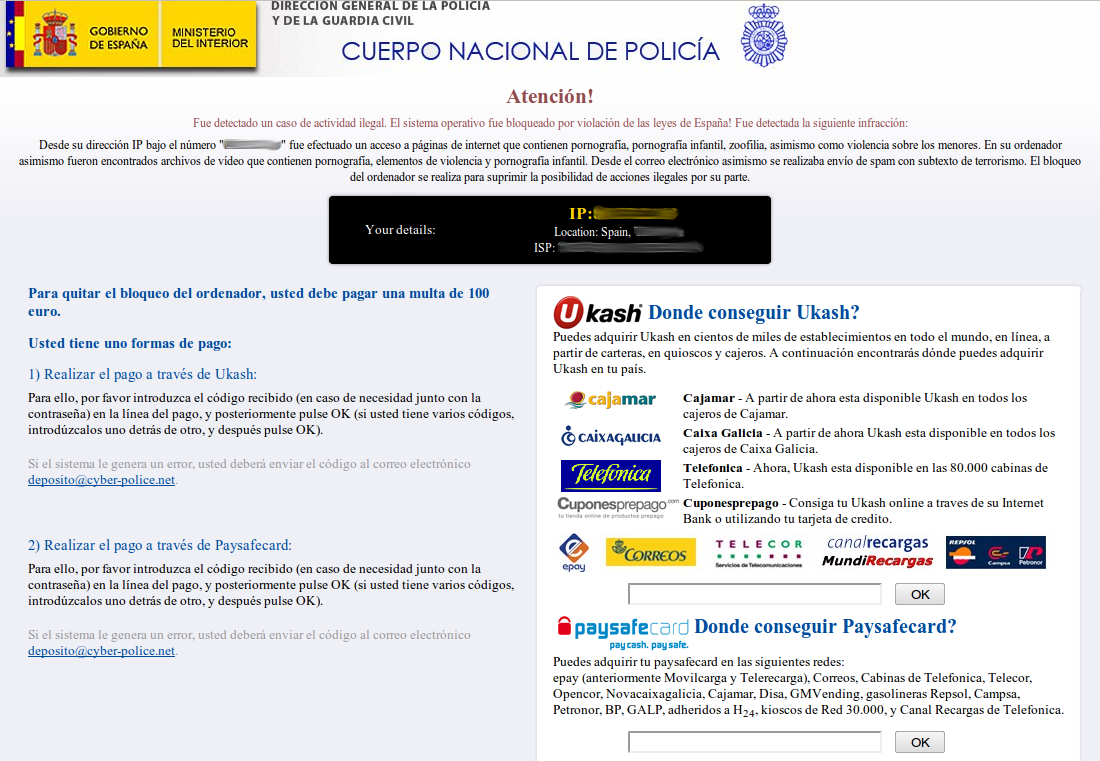
This was an interesting situation so I tried to help my friend. In this case, just after the desktop appeared, a full-screen window showed. It was a warning from the Spanish police ("Cuerpo Nacional de Policía") saying that the system had been blocked because it had been used to perpetrate illegal actions like child pornography, terrorism and violence against children: " Fue detectado un caso de actividad ilegal. El sistema operativo fue bloqueado por violación de las leyes de España!". A warning like this can be shocking for a normal user, so social engineering was working here. However, this warning was also asking for 100€ to be paid via Ukash or Paysafecard as a fine for this behaviour and in order to restore the system. This part can be a bit strange and maybe makes the victims call the police very quickly. Once this window appeared no other action was possible, like execute the Task Manager or return to the desktop, just enter a code to pay.
Submitted by jesparza on Mon, 2012/02/06 - 20:13

|